Explainer
What Does “Gluten-Free” Actually Mean? The 20 ppm Rule and How to Read Labels
“Gluten-free”, “contains no gluten”, “may contain traces of gluten”… what do the words on labels mean, and why does 20 ppm matter so much?
In everyday language, “gluten-free” is taken to mean “no gluten at all”. In food law, though, it has a measurable limit. Under the Codex Alimentarius, which sets international food standards, and under European Union legislation, a food can only be labelled “gluten-free” if it contains no more than 20 milligrams of gluten per kilogram. This is usually written as 20 ppm (20 parts per million). Turkish regulations are in line with this international framework.
How little is 20 ppm?
A kilogram of gluten-free bread can contain at most 20 milligrams of gluten. For comparison, an ordinary slice of wheat bread contains roughly 2–3 grams of gluten, tens of thousands of times the 20 ppm limit. In other words, what we think of as “just a crumb” can push a gluten-free plate far over the limit.
The 20 ppm limit is based on scientific studies showing that the great majority of people with coeliac disease can safely eat products at this level as part of their daily diet.
What the labels say
| Wording | What it means |
|---|---|
| Gluten-free / Contains no gluten | The product contains less than 20 mg/kg of gluten. |
| Very low gluten | Used under EU law for specially processed products containing up to 100 mg/kg of gluten. Generally not recommended for people with coeliac disease. |
| May contain traces of gluten | The manufacturer is warning of possible contamination because gluten is handled in the same facility. This is not a legal threshold. |
| Crossed grain symbol | A logo licensed by national coeliac societies. On its own it is not a legal statement, but it usually indicates independent checks. |
How is 20 ppm protected in a hotel kitchen?
A packaged product is below 20 ppm; the real question is whether it stays at that level once it is in the kitchen. If gluten-free pasta is boiled in the same water as ordinary pasta, or gluten-free bread is warmed in a shared toaster, the figure on the label no longer applies.
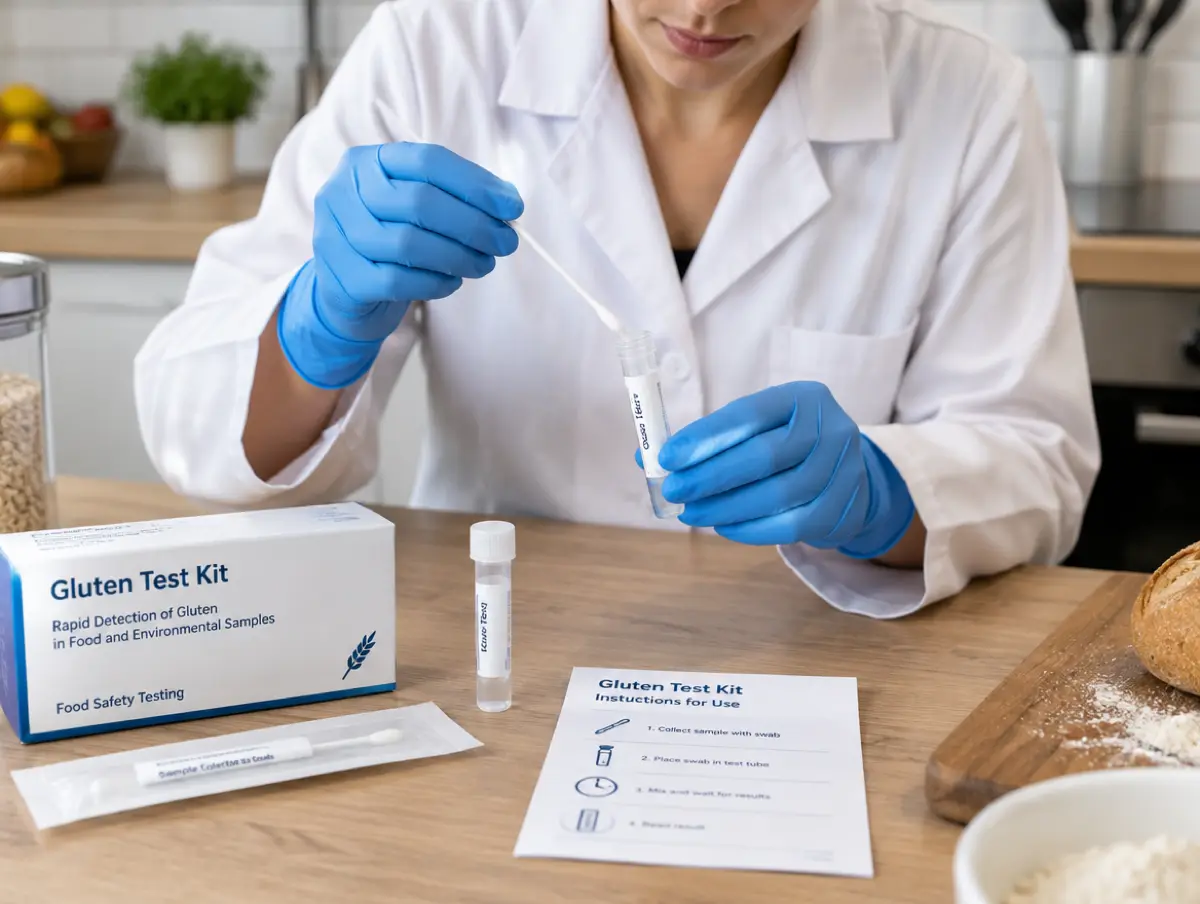
That is why we use two types of test in our hotel inspections:
- Rapid surface tests: these show within minutes whether there is gluten residue on worktops, chopping boards and equipment.
- Laboratory analysis: at Coeliac Expert level, samples are taken from finished plates as they are served and analysed in an accredited laboratory; the result must be below 20 mg/kg.
What can you do as a guest?
- Don’t hesitate to ask to see the packaging of anything the hotel describes as “gluten-free”.
- For unpackaged items (bread, desserts), ask where and how they were made.
- Choose inspected hotels with a clearly stated level: see the list of approved hotels.